AI Photo Generator-Enhance Pic
- 3.6
- Rating
- 1.00M
- Installs
- Free
- Price

 Analysis by App-foxy
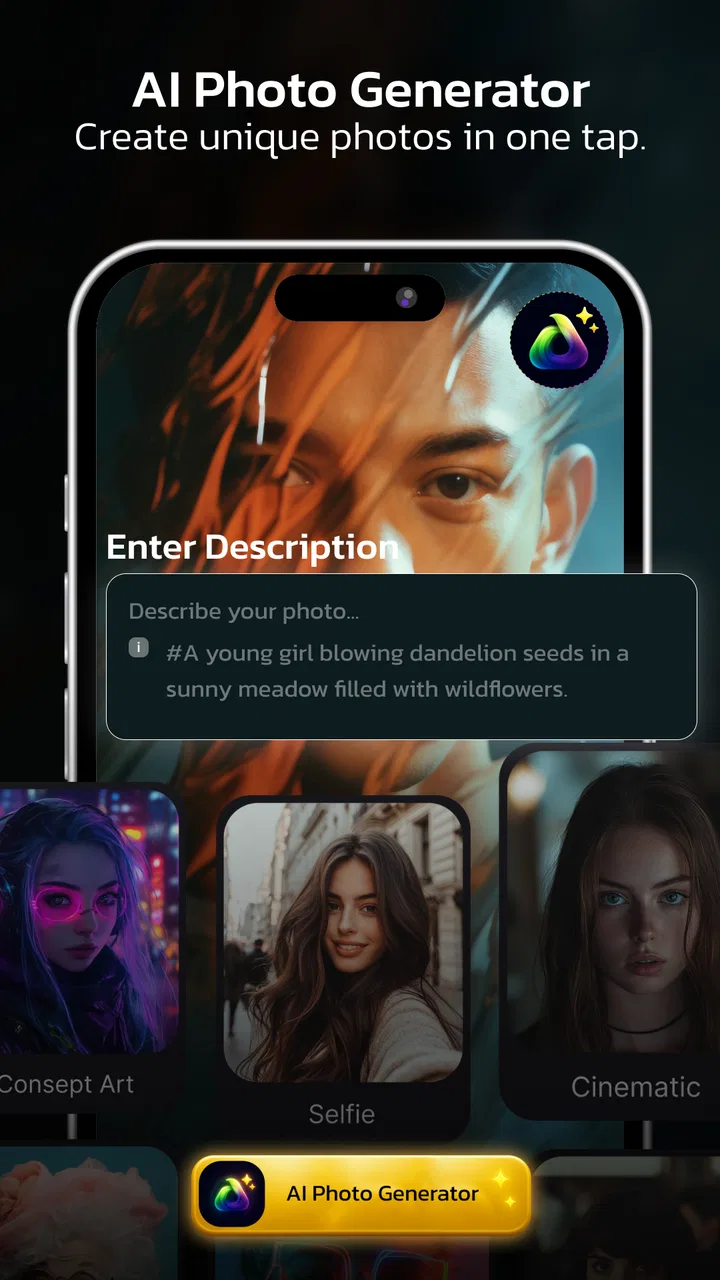
I approached AI Photo Generator-Enhance Pic as a quick creative photography tool rather than a complete replacement for a traditional editor. That distinction matters. Its appeal is the chance to turn an ordinary portrait into something more polished, experiment with face-swapping ideas, and build an image without spending a long time learning complicated controls. In my experience, it is most enjoyable when I treat it as a fast visual playground with practical editing uses, not as a precision retouching studio.
The app comes from Dijital Elma and is available as a free download for everyone. It sits in the photography category, with a 4.1 average from around 200 ratings and over 100,000 installs. Those figures suggest that it has found a real audience, but they also set a sensible expectation: this is a relatively focused tool for casual and creative image work, not a deeply established professional suite.
What the editing experience feels like in everyday use
The first thing I like about this kind of app is the short distance between an idea and a finished image. Instead of opening a full desktop editor, adjusting layers, masks, curves, and export settings, I can begin with a portrait and explore an AI-assisted result. That makes the app particularly convenient when I want to prepare a profile image, make a playful picture for a group chat, or test a visual concept before investing more time in it.
You May Also Like

 Blood Strike: 2.5 Anniversary
Blood Strike’s Loadouts Turn Every Drop Into a Tactical Gamble
A close look at Blood Strike’s custom loadouts: how fast access to signature weapons reshapes its battle royale rhythm, rewards preparation, and narrows the gap between fights.

 Pandora - Music & Podcasts
Pandora’s Music Is Easy to Start, but Harder to Recover
Pandora’s strength is its low-effort path from a seed to a station. Its weak spot is how much confidence it asks you to place in connection, setup, and quiet recovery.

 8 Ball Pool
 Is Built on Rivalries, Rematches, and Routine
A close look at the rivalries, rematches, shared routines, and unanswered safety questions that turn a quick pool match into a persistent mobile community.

 Samsung Music
’s Quiet Strength Is Playing What You Already Own
Its reach comes less from spectacle than from dependable access to a personal library. That simplicity is both the app’s strongest retention engine and its ceiling.

 AccuWeather: Weather Radar
AccuWeather Review: A Quick, Clear Forecast for Everyday Decisions
For everyday plans, the best forecast is the one you can understand quickly. AccuWeather makes rain timing, radar, and local conditions easy to act on, with a few trade-offs.

 Hill Climb Racing
Why Hill Climb Racing Still Turns Crashes Into One More Run
A tiny car, a bumpy hill and one more upgrade: Hill Climb Racing keeps resurfacing because its simple chaos makes every near-miss feel personal.
More From Our News Desk



The main attraction is the combination of portrait creation, face swapping, and AI photo tools in one place. These functions appeal to slightly different moods. Portrait creation is useful when I want a more stylized presentation of myself or someone else. Face swapping is better suited to humorous experiments and imaginative compositions. The broader enhancement tools are the practical side, helping an otherwise ordinary picture feel more finished without requiring advanced editing knowledge.
I found the strongest value in using the app for images that already have a clear subject. A well-lit face with a reasonably simple background gives the AI a better starting point than a dark group photo with overlapping heads. That is not a criticism unique to this app; it is simply the reality of automated portrait work. Still, it changes how I use it. I now choose the source image more carefully instead of assuming the tool can rescue every photograph.
A useful workflow is to keep the original image untouched, make one creative version first, and then compare it with a restrained enhancement. The dramatic result may be entertaining, while the lighter version may be the one I actually use. This two-pass approach prevents the common mistake of accepting the most eye-catching output when a more natural edit would look better in a profile or professional setting.
Where the AI tools are genuinely useful
The app makes the most sense for quick portrait projects. If I have taken a casual selfie and want a more deliberate-looking image, an AI-based portrait treatment can save time. It can also help when I need several visual directions for the same photo: a cleaner personal image, a more playful social version, and a stylized experiment. Having those possibilities close together is more convenient than moving between a camera app, a retouching editor, and a separate face-swap service.
Face swapping has a different strength. It is not necessarily the feature I would use for a serious portrait, but it can be effective for harmless creative scenarios. For example, I might use a pair of consenting friends in a themed joke image, prepare a playful birthday graphic, or explore how two faces work within a costume-style composition. The best results come when the faces are similarly angled and clearly visible. When the source expressions or lighting differ too much, the result can become visibly artificial, which may be exactly what I want for comedy but not for realism.
One less obvious benefit is idea testing. Before arranging a photo session or designing a social post, I can use a rough image to see whether a certain portrait mood is worth pursuing. That makes the app useful as a sketching tool. It does not need to produce the final image every time to be valuable; sometimes it helps me decide what kind of image I want next.
For a small business owner or independent creator, that quick experimentation can be practical. A person preparing a simple announcement could test a portrait treatment before choosing a visual direction. Someone building a personal brand could compare a natural-looking image with a more stylized one and decide which better matches the intended audience. I would still move to a more controlled editor for final commercial work, but this app can help with the early creative stage.
The trade-off between speed and control
The convenience comes from letting the automated tools make many decisions. That is also the central limitation. I can get an attractive result quickly, but I do not approach the same level of control I would expect from a conventional editor with detailed adjustment sliders, masking, layers, and manual correction. When an AI result is almost right but has one distracting detail, the lack of fine control can become frustrating.
This matters most with hair, glasses, hands, jewelry, and busy backgrounds. These areas can influence how believable a portrait feels, yet they are also the places where automated editing often needs supervision. If I am making a casual image, I may accept a small imperfection. If the picture represents my work, a product, or an important event, I would inspect the result closely rather than sharing it immediately.
There is also a creative trade-off. AI tools can make several images feel similar if I rely on the strongest preset or the most dramatic transformation every time. I get better personal results when I use the app to explore options, then choose the version that still looks connected to the original person. In other words, the app works best when I remain the editor and use the automation as assistance.
The free entry point is welcome, but the app includes in-app purchases ranging from $1.49 to $29.99 per item. That makes it important to decide how often I expect to use the more advanced or premium-oriented parts of the experience before spending money. A casual user who only wants occasional experiments may be satisfied without paying. Someone planning regular portrait creation should examine the available purchase choices carefully and consider whether the convenience justifies the cost over time.
I also would not choose this app when my priority is a completely manual workflow. Traditional photo editors remain better for precise color correction, selective retouching, typography, compositing, and repeatable brand work. A dedicated face-editing application may also be preferable if I need detailed control over facial adjustments rather than quick AI-generated alternatives. The right choice depends on whether speed or exactness matters more for the image in front of me.
Practical ways to get better results
I recommend beginning with a single-subject photo in which the face is easy to identify. Avoid starting with a crowded image, an extreme side profile, or a face partly hidden by a hat or shadow. This simple selection step has more impact than repeatedly trying random effects. If the source is weak, changing the tool may not solve the underlying problem.
For face swaps, I would match the source images before applying anything. Similar head angles, comparable lighting, and expressions that are not dramatically different usually create a more coherent result. A straight-on face paired with a sharply turned face gives the system a harder job and can produce an image that looks pasted together. When I want a deliberately funny result, I may ignore this advice, but I do so knowingly.
It is also worth saving the original and reviewing the finished image at full size. A result can look convincing in a small preview while showing rough edges when enlarged. I pay particular attention to the boundary around the face, the eyes, hairline, teeth, and areas where the subject meets the background. This is a small habit, but it separates a usable portrait from an image that only works at a glance.
Another practical tip is to create versions for different purposes instead of forcing one edit to do everything. A highly stylized portrait may be fun for a private message, while a softer enhancement is more appropriate for a public profile. I prefer this approach because it keeps the app’s creative side without allowing the effect to overpower the person in the photograph.
Because the app is rated for Everyone, it is approachable for a broad audience, including people who are not comfortable with complex photography software. That does not mean every generated image is automatically suitable for every situation. I would still use care with other people’s faces, especially when making a face swap, and I would avoid presenting an altered image as an authentic record of an event. Creative editing is most enjoyable when everyone involved understands what the image is.
Who should use it, and who should look elsewhere
I think this app is a good fit for casual photographers, social media users, families making playful images, and beginners who want to explore AI-assisted portrait editing without learning a full professional workflow. It is also useful for anyone who often thinks, “I wonder what this photo would look like in a different style?” The free download lowers the barrier to trying that idea, while the photography focus keeps the experience more specific than a general-purpose design app.
It may also suit creators who need quick concept images. A small content project can benefit from rapid visual variations, especially during brainstorming. The app is valuable in that role because it helps me make decisions earlier: whether a face treatment feels appropriate, whether a composition has enough impact, or whether a particular idea is worth recreating with better photography later.
I would recommend a different option to professional photographers, designers, or anyone who needs exact repeatability. If the same face must be edited consistently across a large set of images, manual controls and dependable project management are more important than instant experimentation. I would also skip this app if I dislike AI-generated changes in general or want every retouching decision to be visible and adjustable.
Device compatibility is reasonably broad, since the current version, 1.3.0, requires Android 7.0 or later. That makes it accessible to people who are not using a recent phone, although the practical experience of AI image processing can still depend on the device and the complexity of the task. I would keep some storage and patience available for image work, particularly when trying several variations rather than stopping after the first result.
My final take on AI Photo Generator-Enhance Pic
After using it as a photography companion, I see AI Photo Generator-Enhance Pic as a convenient middle ground between a basic filter app and a full editing workstation. Its strongest quality is immediacy: I can move from a portrait idea to a shareable experiment without building the image manually. Portrait creation, face swapping, and enhancement tools give it enough range for everyday creativity, while the simple premise makes it approachable.
Its weaknesses are just as clear. Automated results are not consistently suitable for serious or highly controlled work, and the absence of deep manual correction can leave me stuck when a promising image contains one obvious flaw. The purchase range also means frequent users should think about value rather than assuming every part of the experience will remain equally useful at no cost.
My recommendation is straightforward: try it if you want fast, playful portrait editing and are willing to judge each result with your own eyes. Use clean source photos, compare subtle and dramatic versions, and treat face swapping as a creative effect rather than a substitute for careful photography. The app is at its best when it accelerates your ideas without taking away your judgement. For that audience, it is an enjoyable free photography app with real practical value; for precision editors, a traditional tool will still be the better home.
FAQs for AI Photo Generator-Enhance Pic
01What are the main features of AI Photo Generator-Enhance Pic?
AI Photo Generator-Enhance Pic offers a range of features designed to enhance your photography experience. Key features include AI-powered image enhancement, background removal, and color correction. The app also provides filters and effects to add artistic touches to your photos, making it a versatile tool for both casual and professional users.
02Is AI Photo Generator-Enhance Pic free to use?
AI Photo Generator-Enhance Pic is available as a free download with basic features accessible to all users. However, to unlock advanced features and tools, such as high-resolution exports and premium filters, a subscription or one-time purchase may be required. Check the app store for the latest pricing details.
03How does AI Photo Generator-Enhance Pic ensure user privacy?
AI Photo Generator-Enhance Pic prioritizes user privacy by implementing strong data protection measures. The app requires minimal personal information and does not store your photos on external servers without consent. Always review the privacy policy and permissions requested during installation to ensure your data is handled securely.
04Can AI Photo Generator-Enhance Pic be used offline?
Some features of AI Photo Generator-Enhance Pic may be available offline, such as basic editing tools. However, for full functionality, including AI-driven enhancements and updates, an internet connection is typically required. This ensures access to the latest features and cloud-based processing capabilities.
05What devices are compatible with AI Photo Generator-Enhance Pic?
AI Photo Generator-Enhance Pic is compatible with most modern Android and iOS devices. Ensure your device meets the minimum system requirements specified in the app store, such as sufficient RAM and a supported operating system version, to enjoy a smooth and efficient user experience.
Pros
- User-friendly interface
- easy navigation.
- High-quality image enhancements.
- Wide variety of artistic filters.
- Fast processing
- minimal wait time.
- Supports multiple image formats.
Cons
- In-app purchases for premium features.
- Occasional ads can be intrusive.
- Limited free filter options.
- Requires internet for full functionality.
- May consume significant battery life.

AI Photo Generator-Enhance Pic
Gallery